
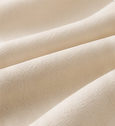
GSM measures fabric mass per square meter. Choose it together with construction, composition, usable width, finishing, and the garment’s intended application.
On this page
Introduction
“What GSM should we use?” is a useful question at the start of apparel development. It is not enough to finish the specification.
GSM describes fabric mass per unit area. It does not describe the complete hand feel, opacity, thermal comfort, stretch, or durability of a garment. Two fabrics with the same GSM can produce very different products.
A lightweight interlock and a single jersey of similar weight may differ in thickness, drape, and surface appearance. A brushed sweatshirt fabric may feel fuller than an unbrushed fabric with a comparable mass.
Choose knit fabric by evaluating GSM and construction together, then confirm the result through garment sampling and relevant testing. Start with the application, not a universal weight chart.
This guide explains how to use GSM correctly, compare common knitted constructions, and turn a general product idea into a specification suitable for sampling and quotation.
What Does GSM Mean in Fabric?
GSM stands for grams per square meter. A fabric weighing 180 GSM has a mass of 180 grams for each square meter of material under the relevant measurement conditions.
This makes GSM useful for comparing fabric weight and estimating material requirements.
However, GSM is not the same as:
- Thickness.
- Yarn count.
- Stitch density.
- Fiber composition.
- Strength.
- Quality.
- Warmth.
Each describes a different characteristic.
A loosely structured fabric made with bulkier yarns can feel thick without being especially dense. A compact fabric can have a substantial weight while appearing relatively smooth and thin.
Why the Measurement Condition Matters
Fabric mass can be affected by moisture and processing state. Finished, conditioned fabric should be compared with material assessed under equivalent conditions.
Ask whether the stated weight refers to greige fabric, finished fabric, or fabric after washing.
For buying purposes, specify the finished condition and an agreed tolerance. If post-wash weight is relevant to the product, record that separately.
A single number without a measurement basis can create disagreement between development and delivery.
Is Higher GSM Better Quality?
No. Higher GSM means more mass per square meter, not automatically better quality.
A heavy fabric may still have poor dimensional stability, inconsistent shade, weak surface appearance, or unsuitable drape.
A lightweight fabric can be well engineered for a summer top or layering garment.
Quality means meeting the product’s requirements consistently. Relevant questions include:
- Does the fabric provide the required coverage?
- Does it retain acceptable dimensions after care?
- Does the surface remain suitable for the product?
- Is the color consistent?
- Does the garment fit and move as intended?
- Can production reproduce the approved material?
A buyer who uses weight as the only quality measure may pay for material that makes the garment less suitable.
Start with the Garment Application
Before selecting a weight range, define the garment.
An adult promotional T-shirt, a premium relaxed-fit tee, and a fitted fashion top may all use jersey, but they may require different drape, opacity, and recovery.
Write an application brief covering:
- Garment type and fit.
- Season and expected wearing conditions.
- Fiber preference.
- Desired hand feel and surface.
- Decoration.
- Care conditions.
- Target price and quantity.
- Performance requirements.
Then request a small set of comparable options.
The following ranges are illustrative development starting points, not industry standards or guaranteed suitability.
| Application | Illustrative finished weight range | Constructions worth evaluating |
|---|---|---|
| Lightweight casual T-shirts | Approximately 130–170 GSM | Single jersey |
| General everyday T-shirts | Approximately 170–210 GSM | Single jersey; selected interlocks |
| Structured or heavyweight tees | Approximately 210–280 GSM | Compact jersey; suitable double knits |
| Polo shirts | Approximately 180–250 GSM | Pique and related textured knits |
| Sweatshirts and casual layers | Approximately 240–360 GSM | French terry; fleece |
Actual products can fall outside these ranges. Fiber, yarn, finishing, fit, and customer expectations determine whether a material works.
Single Jersey: A Common Starting Point for T-Shirts
Single jersey is widely used for T-shirts because it can offer a useful combination of softness, drape, and production flexibility.
Its face and reverse have different appearances. Cut edges may curl, which can affect handling during garment manufacture.
Single jersey can work across a broad weight range. A lighter version may suit a fluid summer top, while a heavier version may create a more substantial casual garment.
What Buyers Should Check
Evaluate:
- Coverage in the intended color.
- Drape on the actual silhouette.
- Dimensional change.
- Spirality or garment twisting.
- Surface appearance after washing.
- Edge behavior during cutting and sewing.
- Compatibility with printing.
A sample card cannot show all of these characteristics. A trial garment is particularly valuable when the intended style depends on drape or a clean side-seam appearance.
When Jersey May Need Further Development
If the first sample feels too thin, adding weight is only one possible response.
A different yarn, stitch setting, composition, or finish may provide a better balance. Ask the supplier to explain the proposed change and its likely effects.
Changing several variables at once makes it difficult to understand why the next sample performs differently.
Interlock: Consider Structure as Well as Weight
Interlock is a double-knit construction that often provides a smoother, more substantial feel than a comparable lightweight single jersey.
It can be useful where buyers want a cleaner surface, fuller hand, or a particular degree of coverage.
However, interlock should not be assumed to be automatically more durable, more stable, or better for every T-shirt.
Those outcomes depend on the complete fabric specification.
Questions to Ask About Interlock
Ask how the proposed material compares with the jersey alternative in:
- Finished thickness and drape.
- Stretch and recovery.
- Garment weight.
- Drying behavior.
- Cutting consumption.
- Shrinkage.
- Price per usable garment.
A fabric that looks attractive flat may create too much bulk at seams or feel too warm for the intended product.
Use a garment trial to judge the finished result.
Pique: A Practical Option for Polo Development
Pique fabrics have a textured appearance associated with many polo shirts.
The texture can contribute to the product’s visual identity, but “pique” does not describe one universal material. Different constructions and yarn choices create different surfaces and performance.
For a polo program, the body fabric must also work with the collar, cuff, placket, and decoration.
Review the Complete Polo
Check:
- Whether the collar retains the intended appearance.
- Whether body and rib colors match acceptably.
- Whether the placket distorts.
- Whether embroidery causes puckering.
- Whether body and trims change dimensions compatibly.
- Whether the texture suits the brand’s visual expectations.
A body-fabric approval should not be treated as approval of the complete garment.
If uniforms will be reordered, retain references for both fabric and matching components.
French Terry and Fleece: Similar Categories, Different Results
French terry commonly has loops on the reverse. Fleece commonly has a raised or brushed reverse that creates a different surface and feel.
Both categories include many variations.
For sweatshirt sourcing, clarify the construction, yarn arrangement, face appearance, reverse treatment, and total composition.
A brushed surface may feel soft initially, but buyers should also assess lint, pilling, and changes after laundering.
Match the Reverse Surface to the Application
An unbrushed loop-back fabric may suit a particular transitional layer. A brushed reverse may suit a product intended to feel warmer and softer against the body.
Neither is automatically superior.
Review the garment’s intended season, fit, layering use, and care conditions. If the product will have a large print, assess the face surface and its compatibility with the decoration process.
Rib: Coordinate It with the Main Fabric
Rib is often used for neckbands, cuffs, and waistbands. Its role is different from that of the main body fabric.
A rib that looks correct before sewing may recover poorly, distort the opening, or shrink differently from the body.
When developing a garment, specify whether elastane is required and how the rib should behave in the finished product.
Assess the assembled garment after care. Look for neckline waviness, cuff growth, waistband distortion, and color mismatch.
Replacing only the body fabric in an existing style can still require a new trim evaluation.
Mid-Article Specification Checkpoint
At this stage, a useful request might read:
“We are developing a casual adult T-shirt with a relaxed fit. Please suggest cotton-rich single jersey options around our target finished weight, with suitable coverage in white and compatibility with screen printing.”
The next step is to add your preferred composition, care requirements, quantity, width needs, and test expectations.
Send your garment application and target GSM to request a focused fabric recommendation and sample selection.
A clear brief produces more useful samples than asking only for “premium quality fabric.”
How GSM Affects Material Consumption
Weight is relevant to cost, but purchasing decisions should connect it to usable area.
For a simplified calculation:
Kilograms per linear meter = GSM × usable width in meters ÷ 1,000
For example, a hypothetical fabric at 200 GSM and 1.80 meters usable width has a theoretical mass of:
200 × 1.80 ÷ 1,000 = 0.36 kilograms per linear meter.
If its hypothetical price is $5 per kilogram, the corresponding theoretical fabric cost is $1.80 per linear meter.
This example excludes losses, defects, taxes, freight, and other costs. It demonstrates the conversion, not a market quotation.
Why Width Must Be Included
A lower kilogram price does not necessarily mean lower garment cost.
Usable width affects marker efficiency. Two fabrics with different widths may require different consumption for the same pattern.
Confirm whether the quoted width is total width or usable width. Also clarify whether the fabric is supplied open-width or tubular.
Your garment maker should assess consumption using the intended patterns and the actual proposed width.
Set Weight Tolerances Before Ordering
Finished weight can vary. A workable specification defines the target, tolerance, sampling approach, and response to results outside the agreement.
Avoid selecting a tolerance simply because it looks familiar.
It should reflect the product’s sensitivity, manufacturing capability, and commercial agreement.
For example, a fitted lightweight garment may respond differently to variation than a loose sweatshirt.
Coordinate Weight with Other Requirements
A supplier should not meet the GSM target by creating an unacceptable width or dimensional-change result.
Review weight, width, hand feel, and shrinkage together.
If a sample reaches the target weight only after a finishing change, assess how that change affects the other properties.
The approval should represent a balanced specification that can be repeated in bulk production.
Opacity, Color, and Surface Should Be Assessed Separately
Weight influences coverage, but color and construction also matter.
A white fabric may require closer coverage evaluation than a dark version. Stretching the material on the body can change its appearance.
Check the intended garment in realistic lighting and fit conditions. Include any product-specific modesty or coverage requirements.
For printed products, examine the surface under the planned decoration. A textured material may produce a different visual result from a smooth jersey even at the same weight.
Do not approve every color from one sample if the collection includes materially different shades or finishes.
Dimensional Stability and Twist Can Change the Decision
A fabric that meets its initial GSM target may still fail the garment application after laundering.
Knit shrinkage is connected to material specification and processing, so finished weight cannot substitute for dimensional testing. See the CottonWorks technical resource on cotton-knit processing.
Record:
- Initial fabric dimensions.
- Care procedure.
- Post-care dimensional change.
- Garment appearance.
- Side-seam alignment.
- Changes in surface and hand feel.
Where twisting is a concern, assess a representative garment. A small swatch may not communicate the commercial impact as clearly as a washed T-shirt.
A Practical Development Sequence
1. Choose the Application
Decide what the garment must do and how it should feel.
2. Select Two or Three Constructions
Choose a narrow comparison set. For example, compare a jersey and an interlock for a structured tee rather than reviewing unrelated materials.
3. Narrow the Weight
Use the intended fit, coverage, and season to select an initial range.
4. Confirm Fiber and Finish
Check how composition and finishing affect the desired result.
5. Produce Garment Samples
Use actual trims and decoration where practical.
6. Evaluate Care Performance
Assess appearance and fit after the agreed care process.
7. Approve a Complete Specification
Record construction, composition, finished weight, usable width, finishing, tolerances, and relevant test requirements.
This sequence reduces repeated sampling caused by choosing a GSM before defining the product.
FAQ
What GSM is best for T-shirts?
There is no universal best GSM. Many everyday tees are developed within a moderate weight range, but the correct choice depends on fit, climate, opacity, construction, and brand positioning. Compare garment samples rather than selecting a number alone.
Is 200 GSM fabric always thicker than 180 GSM fabric?
No. Thickness also depends on yarn, structure, density, and finishing. A bulkier lower-weight fabric can feel thicker than a compact higher-weight fabric.
Is single jersey better than interlock?
They serve different design needs. Single jersey is often selected for familiar T-shirt drape, while interlock may offer a fuller structure. Evaluate the intended garment and care performance.
Can the same GSM be used for cotton and cotton-polyester?
Yes, but equal GSM does not guarantee equal hand feel, coverage, moisture behavior, or dimensional stability.
Should GSM be measured before or after washing?
For procurement, clearly define the measurement condition. Finished fabric weight and post-wash weight answer different questions. Use consistent conditions for comparisons.
Why does usable width matter?
It affects cutting layout and garment consumption. A fabric’s kilogram price and GSM cannot establish garment cost without considering width and cutting efficiency.
Conclusion
GSM is a valuable specification tool when used with construction, composition, width, finishing, and garment testing.
The most reliable choice begins with the product application. Select a suitable structure, narrow the weight, and assess the finished garment under the intended care conditions.
A complete approval protects the buyer more effectively than a weight number alone.
Request Fabric Options for Your Application
Send your garment type, preferred composition, target GSM, desired hand feel, colors, usable-width requirements, and expected quantity.
Ask for a fabric catalog or a focused sample recommendation to compare suitable options before finalizing your specification.
General purchasing guidance from HYMO Textile. Product specifications, testing arrangements, and supply terms must be confirmed for your application. Illustrative ranges and calculations are not quotations or guarantees.