
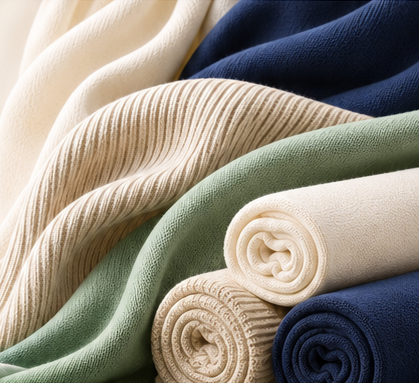
Choose cotton or cotton-polyester by comparing the finished fabric’s hand feel, dimensional stability, surface appearance, decoration compatibility, and garment cost.
On this page
Introduction
Choosing between cotton and cotton-polyester knit fabric is rarely a simple choice between comfort and durability. For an apparel buyer, the real decision involves the garment’s purpose, target price, care instructions, decoration method, and expected appearance after repeated use.
A fabric that feels excellent on a sample card may behave differently after cutting, sewing, printing, and laundering. Likewise, a blend that looks economical per kilogram may become expensive if its usable width, cutting yield, or shade consistency creates production problems.
The practical answer is to choose cotton when cotton hand feel and absorbency are central to the product, and consider cotton-polyester when your priorities include balancing those characteristics with synthetic-fiber performance. In both cases, approve the finished fabric through testing rather than relying on fiber percentages alone.
This guide explains how to compare the options, interpret common blend descriptions, and prepare a specification that a fabric supplier can quote accurately.
What Is the Difference Between Cotton and Cotton-Polyester Knit Fabric?
Cotton knit fabric is made using cotton fibers. Cotton-polyester knit fabric combines cotton and polyester, either within blended yarns or through a fabric construction using different yarn components.
That distinction matters. Two fabrics with the same overall fiber composition can feel and perform differently because their fibers are arranged differently.
For example, a uniformly blended single jersey may behave differently from a sweatshirt construction with different face and backing yarns. The label describes overall composition, but it does not fully explain which fibers dominate the garment surface.
When evaluating a material, ask for more than the percentage:
- Fiber composition and how it is expressed.
- Yarn type and yarn count.
- Knitted construction.
- Finished weight and usable width.
- Finishing treatment.
- Intended care conditions.
- Relevant performance results.
These details turn a general material description into a usable purchasing specification.
What Do CVC and TC Mean?
CVC commonly refers to a cotton-rich cotton-polyester blend. TC commonly refers to a polyester-rich polyester-cotton blend.
However, these commercial abbreviations should never replace an explicit composition statement. Terminology can vary between suppliers, and percentage order can be misunderstood.
Write “60% cotton / 40% polyester,” for example, rather than ordering only “60/40 fabric.” The numbers here illustrate how to state a specification; they are not a recommended ratio for every application.
Also confirm whether the stated composition applies to the complete fabric or a specific component. This becomes particularly important with fleece, plated fabrics, and other constructions that use different yarn systems.
Compare the Finished Product, Not Just the Fiber Label
The following comparison provides a starting point for development. It describes general tendencies, not guaranteed performance.
| Buying consideration | Cotton knit | Cotton-polyester knit |
|---|---|---|
| Hand feel | Often selected for a familiar cotton touch | Can range from cotton-like to noticeably synthetic |
| Moisture behavior | Cotton absorbs moisture | Depends on blend, construction, and finishing |
| Drying behavior | Can retain absorbed moisture | May dry faster under comparable conditions, but requires verification |
| Dimensional stability | Sensitive to construction and processing | Polyester may contribute stability, without eliminating testing |
| Pilling | Influenced by yarn and surface characteristics | Also influenced by yarn and surface; stronger fibers can retain pills |
| Decoration | Must match the printing system | Must consider both fiber types and processing temperatures |
| Cost | Depends on fiber, yarn, construction, and finish | Also depends on the complete specification |
| Product positioning | Useful where cotton content is a selling requirement | Useful where a balance of characteristics is required |
A comparison becomes meaningful only when fabric weight, construction, finishing, and care conditions are reasonably comparable.
Comparing a lightweight cotton jersey with a heavier cotton-polyester interlock does not isolate the effect of fiber composition. The resulting differences could come largely from fabric structure.
How Cotton Content Affects Comfort
Comfort includes several separate experiences: surface softness, heat perception, moisture absorption, garment fit, and freedom of movement.
Cotton’s absorbency can be useful in everyday apparel. However, absorbency does not automatically mean that a garment will feel dry during prolonged activity.
A fabric may absorb perspiration while retaining moisture. Another fabric may absorb less but move or release moisture differently because of its yarns, construction, or finish.
For active products, avoid broad statements such as “breathable because it contains cotton” or “moisture-wicking because it contains polyester.”
Instead, define the actual requirement:
- Is the product for everyday casual wear or sustained exercise?
- Will it be worn in hot, humid conditions?
- Is the desired benefit absorbency, moisture transport, or drying speed?
- Will a performance finish remain effective after laundering?
A useful sample review includes wear evaluation under relevant conditions, supported by appropriate laboratory testing where a performance claim will be made.
Softness Must Be Evaluated After Washing
Initial softness can be influenced by finishing treatments. A fabric that feels very smooth when delivered may change after washing.
Keep an unwashed control and compare it with washed specimens. Review surface feel, thickness, drape, and appearance under consistent conditions.
For a repeat program, the approved standard should describe the desired hand feel after the relevant care treatment, rather than relying entirely on a fresh sample.
Shrinkage, Shape Retention, and Garment Fit
Knit fabrics can change dimensions as stresses introduced during processing are released. Fiber content matters, but knitting, dyeing, finishing, and garment care also affect the result.
CottonWorks identifies processing distortion and fabric construction as important considerations in cotton-knit shrinkage. That supports a practical buying rule: a composition statement alone cannot predict dimensional performance. Read the CottonWorks guidance on shrinkage and skewing.
A cotton-polyester blend may offer useful dimensional stability, but “contains polyester” is not an acceptance criterion.
For procurement, specify:
- The agreed test method.
- The washing and drying procedure.
- The number of cycles.
- Length and width measurement directions.
- The acceptance limits.
- Whether assessment applies to fabric, garments, or both.
Why a Fabric Test and a Garment Test Serve Different Purposes
Fabric testing helps evaluate the material before cutting. Garment testing adds the effects of patterns, seams, trims, and manufacturing.
For instance, a body fabric and rib neckline may change dimensions differently. A fabric-level result cannot fully predict how the finished neckline will look.
Before production approval, make a garment using the intended components and care process. Check body length, chest width, side-seam alignment, collar shape, and overall appearance.
Treat this as a product-development step, especially when changing blend ratio or construction within an established style.
Pilling and Surface Appearance
Neither cotton nor cotton-polyester should be described as universally pill-free.
Pilling depends on fiber characteristics, yarn structure, knitting, surface treatment, and abrasion during wear. Brushing or other finishes can change how readily loose fibers become available at the surface.
For blends, it is particularly important to assess the finished fabric rather than assume polyester automatically improves appearance.
A pilling requirement should identify the method, assessment stage, and acceptance rating. Different procedures can produce different results, so a grade without its method provides incomplete information.
Review the Appearance Customers Will Actually See
For a dark casual T-shirt, light-colored pills may be visually prominent. For a brushed sweatshirt, changes in surface texture may matter as much as a numerical grade.
Evaluate representative colors and finishes. If the fabric will be used in a high-friction area or worn with bags and outer layers, include that use pattern in product review.
Factory testing can support development, but the report should identify the actual sample and test conditions. A report for another fabric is background information, not proof of the proposed order.
Printing, Embroidery, and Heat Processing
Decoration should be considered before the fabric is finalized.
Cotton, polyester, and their blends can require different inks, pretreatments, curing conditions, and process controls. Some polyester-containing fabrics can present dye migration concerns during heat processing, depending on the dyes and application.
Before committing to bulk fabric, give the decorator:
- Fiber composition.
- Fabric construction and weight.
- Color and dye information where available.
- Finishing details relevant to printing.
- Intended decoration method.
- Proposed curing or pressing conditions.
Test the actual combination of fabric, color, artwork, and process.
Do Not Approve Decoration from a Different Substrate
A successful print on a white cotton sample does not establish performance on a dark cotton-polyester bulk fabric.
Assess adhesion, color appearance, cracking where relevant, fabric distortion, and post-wash performance.
For embroidery, review puckering, backing requirements, stitch density, and whether the material supports the design without excessive stiffness.
Which Material Fits Common Apparel Applications?
Everyday T-Shirts
Cotton can be appropriate when buyers prioritize a cotton hand feel and cotton-content positioning.
Cotton-polyester can suit programs seeking a different balance of care behavior, durability, and price.
For either option, evaluate opacity, neckline compatibility, shrinkage, pilling, and decoration. A fabric that suits a relaxed adult style may not suit a fitted or lightweight style.
Uniforms and Promotional Apparel
Uniform buyers often place more weight on repeat availability, color consistency, decoration, and laundering behavior.
A blend may be worth evaluating, but the specification should reflect the actual care environment.
A polo washed occasionally at home and a uniform subjected to a demanding commercial process are different products. The intended laundry conditions should be shared before sampling.
Sweatshirts and Casual Layers
Fiber distribution, backing structure, brushing, and finishing can strongly affect sweatshirt performance.
Ask whether the face and reverse have different yarn compositions. Evaluate lint, pilling, bulk, seam behavior, and appearance after washing.
A single total-composition number may conceal details that matter for printing or skin contact.
Stretch Styles
Cotton-polyester blends do not automatically provide the stretch and recovery required for close-fitting apparel.
Knitted construction provides some mechanical stretch, but applications requiring controlled recovery may need a different structure or an elastane-containing material.
Define the required movement and recovery through product evaluation. Avoid using “stretch” as an undefined marketing term in a purchase specification.
How to Compare Cost Correctly
Price per kilogram is useful, but it does not show the full cost of making a garment.
A proper comparison includes finished weight, usable width, cutting efficiency, defect allowance, processing needs, and garment rejection risk.
Consider two hypothetical quotations with different weights and widths. Even if one has a lower kilogram price, it may produce fewer acceptable garment panels.
Ask your garment maker to estimate consumption using the actual pattern and proposed fabric specifications.
Include extra costs associated with:
- Additional relaxation or handling.
- Shade separation.
- Printing trials.
- Recutting defective panels.
- Inspection.
- Rework or delayed production.
This approach keeps material selection connected to garment economics.
Mid-Article Procurement Checkpoint
Before requesting another round of samples, prepare a short application brief.
Include the garment type, intended market, target weight, preferred composition, decoration method, care conditions, and expected order quantity.
Need help comparing cotton and cotton-polyester options? Send your product application and target specifications to request a focused sample comparison.
A focused request helps a supplier recommend relevant constructions instead of sending a broad, difficult-to-compare sample collection.
A Sample Approval Process Buyers Can Use
Step 1: Establish a Reference
Use a physical reference, written specification, or both.
Describe what should match: hand feel, weight, construction, color, drape, or performance. A reference garment may contain several characteristics that cannot all be reproduced at the target price.
State priorities clearly.
Step 2: Compare Samples Under Consistent Conditions
Compare equivalent colors and weights where possible. Identify every sample and record its composition, construction, and finishing.
Keep written observations. “Sample B feels better” is less useful than “Sample B has the preferred drape, but its washed surface needs review.”
Step 3: Test the Intended Care Process
Use the planned care conditions and agreed test procedures. Review dimensional change, appearance, color behavior, and any application-specific requirements.
Do not turn an illustrative development target into a supplier promise without agreement.
Step 4: Make a Trial Garment
Use the intended sewing, decoration, and trim combination.
Check whether the fabric feeds consistently, whether seams distort, and whether the finished silhouette matches the design.
Step 5: Connect Approval to Bulk Production
An approved sample should be identifiable. Record its reference number, date, specifications, and conditions of approval.
Agree which characteristics will be checked during bulk production and shipment inspection. This closes the gap between choosing a material and receiving a consistent order.
FAQ
Is cotton-polyester better than 100% cotton for T-shirts?
Neither is universally better. Cotton may suit a product centered on cotton hand feel and absorbency. Cotton-polyester may suit a different balance of care behavior, surface characteristics, and cost. Compare finished samples using the intended garment and care conditions.
Does cotton-polyester fabric shrink?
It can. The amount depends on composition, knitted structure, processing, finishing, and laundering. Polyester content does not remove the need for dimensional-change testing.
What is the best cotton-polyester ratio?
There is no single best ratio. Start with the garment application, target hand feel, decoration, care conditions, and price. Compare explicit compositions rather than choosing only by labels such as CVC or TC.
Is cotton-polyester suitable for hot weather?
It can be, but comfort depends on more than fiber content. Weight, thickness, fit, construction, and moisture behavior all matter. Evaluate the actual product in conditions relevant to its intended use.
Will a higher cotton percentage prevent pilling?
Not necessarily. Yarn quality, structure, surface finishing, and use conditions influence pilling. Require testing on the proposed finished fabric.
Can I use the same printing process for cotton and blends?
Do not assume so. Confirm the process with the decorator and test the actual fabric, color, and artwork before bulk production.
Conclusion
Cotton and cotton-polyester are material options with different possibilities, not fixed quality grades.
A reliable choice begins with the garment’s use and ends with evidence from the finished fabric and trial garment. Composition, construction, weight, finishing, decoration, and laundering should be assessed together.
The best purchasing decision is the one that connects a clear product brief to an approved sample and an agreed bulk specification.
Send Your Fabric Requirements
Developing a T-shirt, polo, or sweatshirt range? Send your intended application, preferred composition, target GSM, colors, decoration method, and estimated quantity.
Request suitable fabric options and a quotation based on your requirements. Include any testing needs so the proposed material can be assessed against the right criteria.
General purchasing guidance from HYMO Textile. Product specifications, testing arrangements, and supply terms must be confirmed for your application. Illustrative ranges and calculations are not quotations or guarantees.